
Consumption and delivery cycle
Consumption, peak demand, delivery frequency and reserve cover shape the required capacity. Expected fleet growth also forms part of the storage requirement.
Build an initial capacity estimateOnsite commercial storage
We specify and supply commercial fuel storage tanks around your capacity, footprint, access, fuel and control requirements.
A tank can be supplied as storage alone or developed into a connected fuelling point with dispensing, identification, monitoring and reporting.
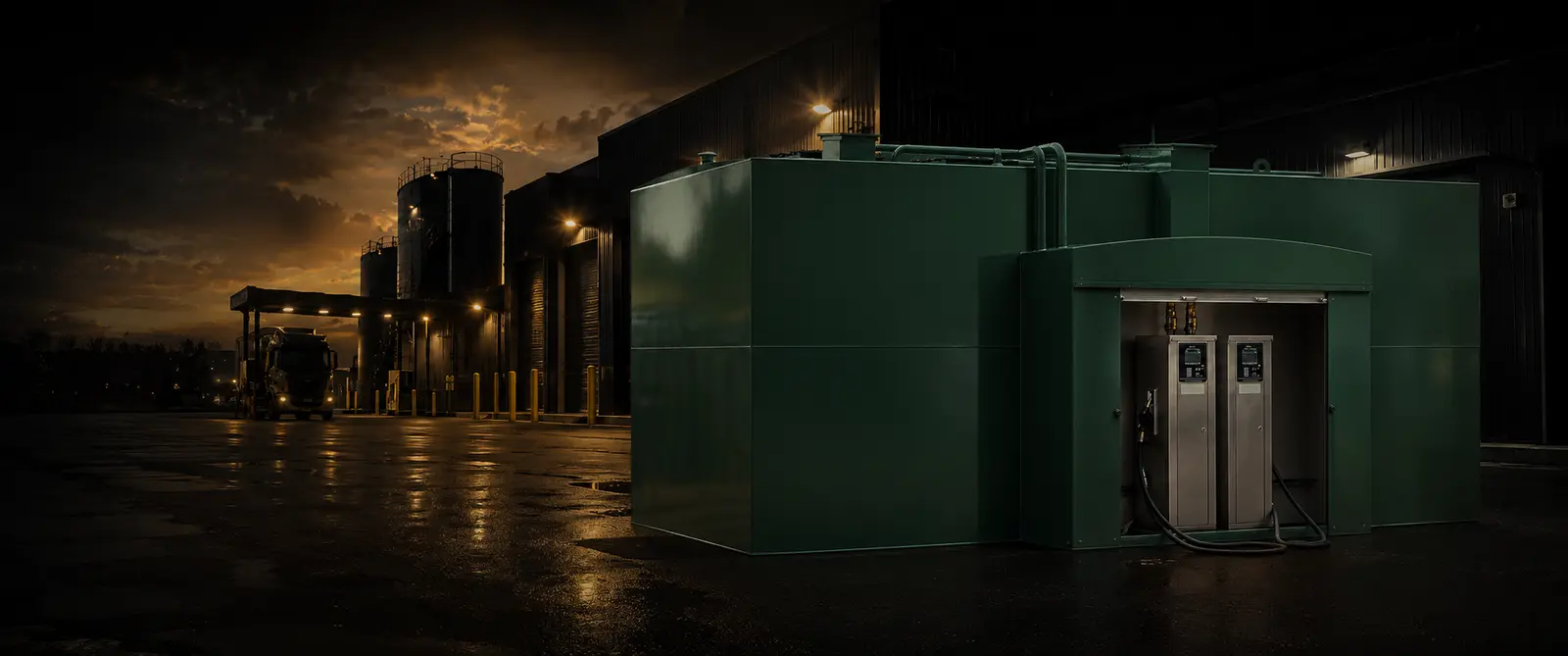
Start with the operation
The FS tank range includes standard rectangular formats and bespoke sizes, shapes, partitions and colours.
Consumption, peak demand, delivery frequency and reserve cover shape the required capacity. Expected fleet growth also forms part of the storage requirement.
Build an initial capacity estimateThe overall layout allows for the tank, pumps, hose movement, tanker access and vehicle approach, so the equipment fits the complete fuel point.
Review tank configuration requirementsDiesel, AdBlue and heating oil need the appropriate storage and supply arrangements. Separate compartments and compatible pipework keep each product distinct.
See how storage connects to dispensingTankWatch adds stock, ullage, delivery and configured alarm information. Connected fuel controls record authorised issues for FMO reporting.
Compare tank monitoring and fuel controlTank options
Your tank configuration
Materials, capacity, bunding, alarms, pipework and filling arrangements are matched to the stored product, tank design and installation.
The online calculator is an early planning tool. It does not replace engineering design, site assessment or the final certified tank specification.
| Arrangement | Role of the equipment | Define for your site |
|---|---|---|
| Storage alone | A tank specified for the required product and capacity. Dispensing and reporting are separate choices. | Product, usable capacity, available footprint, delivery access and the connection to any existing fuel point. |
| Storage with dispensing | Adds the specified pump, meter, hose and nozzle arrangement to create a usable fuelling point. | Vehicle approach, fill sizes, hose use, tank supply and the number of positions needed together. |
| Storage with managed dispensing | Adds identification, authorisation and transaction recording to the dispensing process, with configured FMO reporting. | Who or what is identified, permitted fuel access, required readings and responsibility for maintaining records. |
| Storage with tank monitoring | Tankwatch adds measured stock, ullage, delivery and configured alarm information. It can accompany managed dispensing. | Tank and probe details, the conditions to monitor, local or remote information needs and who reviews the readings. |
Partitioned storage is a separate configuration decision: define the capacity, product and equipment for each compartment. These arrangements describe roles; they are not fixed packages.
Stored fuel information
Tankwatch can provide a local view of stored volume and available capacity for the configured tank.
Review recorded changes in tank contents rather than relying only on manual readings or calculated book stock.
Configured alarms can draw attention to selected tank conditions or unusual stock movements.
Connected tank information
With TankWatch and connected Fueltek controls, FMO brings measured tank stock and recorded fuel issues into the wider fuel-management view. Storage alone does not provide transaction reporting.
Example FMO screens · Views and records depend on the connected equipment and account permissions. Select an image to view it full size.
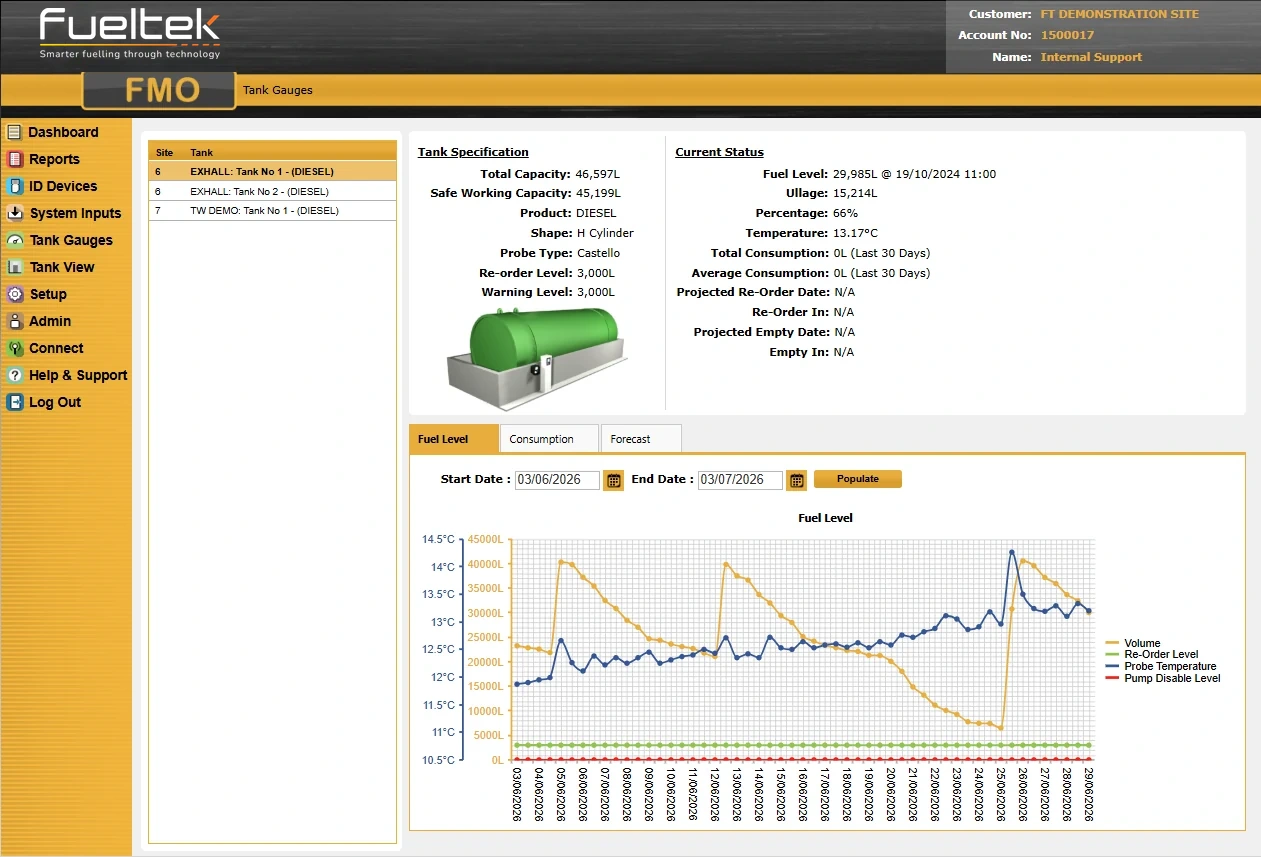
With TankWatch and FMO configured, tank readings and level history add visibility to the storage installation.
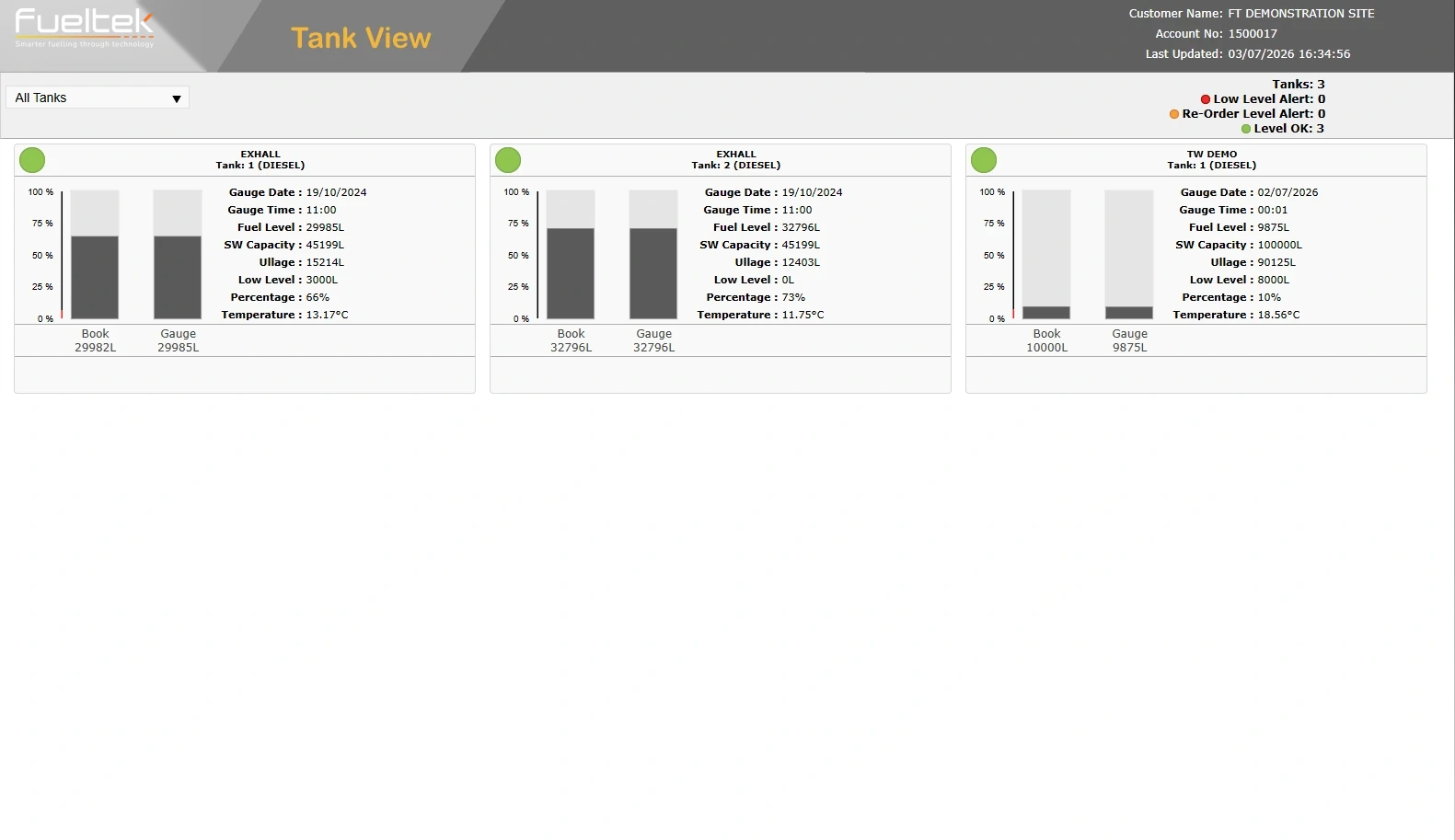
The overview shows received stock figures, book/gauge comparisons and tank status. Tank-only supply does not provide these views.
Questions to answer
Fuel consumption, peak demand, delivery frequency, available space and reserve cover determine the storage requirement. The calculator gives an initial capacity estimate; we help you develop the complete tank arrangement.
Fueltek can develop an integrated fuel storage and dispensing system where the operating requirement calls for storage, pumping, identification, monitoring and reporting to work together.
Possibly. Condition, construction, pipework, existing equipment and compatibility must be inspected before Fueltek recommends integration, retrofit, repair or replacement.
Next step
We specify capacity, stored products, delivery access and connected equipment around your operation and site layout.
Technical information
We specify and supply commercial fuel storage tanks and integrate the dispensing, monitoring and fuel management equipment around your operation.
FS tanks use high-grade mild steel, with the primary storage tank inside a fully enclosed bund providing secondary containment equivalent to 110% of the primary tank capacity. Bund space is separate from usable fuel capacity.
FS steel tanks are built to the applicable construction standard for their design and duty, including BS 799. BS 2594/prEN 12285 and BS 2654 are relevant to earlier tank designs; the table explains their different applications.
The tank’s drawing, identification, inspection and test records define its construction. The applicable standard depends on its shape, capacity, stored product and intended duty.
| Reference | Scope or context | Application |
|---|---|---|
| BS 799 / BS 799-5:2010 | Part 5 covers construction and testing of specified aboveground static carbon-steel oil-storage tanks. | Application depends on the tank form and design duty. BSI scope. |
| BS 2594 / prEN 12285 | BS 2594 and prEN 12285 are legacy references associated with earlier steel-tank designs. “prEN” denotes a draft European standard, rather than a current dated standard. | These references help identify existing equipment. New tanks use the applicable full construction standard and part for their design. |
| BS EN 12285-2:2005 | Addresses workshop-fabricated horizontal cylindrical steel tanks for aboveground storage within its stated limits. | This standard applies to horizontal cylindrical tanks within its scope; rectangular tanks use their applicable design standards. BSI scope. |
| BS 2654:1989 | Historical standard for welded vertical steel petroleum-storage tanks; withdrawn in February 2005. | Relevant to the identification of existing vertical steel tanks rather than current range-wide certification. BSI status. |
Technical information
Nominal capacity, the operating envelope and the equipped tank layout need to be agreed together.
Partitioned arrangements can separate diesel and gas oil. AdBlue requires a dedicated compatible tank or compartment and transfer path; it must not share the diesel wetted components. Identify each product, filling point and outlet.
Plate thickness, reinforcement, protective finish and colour depend on the tank design. Standard sizes are shown below. We also supply non-standard sizes and shapes, with tank prices based on capacity and no additional charge for non-standard dimensions. Company colours are available at no extra cost.
The overall space requirement includes cabinet doors or shutters, maintenance access, hose movement, tanker filling and vehicle protection, as well as the tank body.
Tank identification and serial numbers link the equipment to its drawing, design basis, inspection and testing records, helping with commissioning and future servicing.
FS fuel storage tanks carry a 20-year manufacturer’s guarantee on the tank structure. Pumps, controls and other equipment have their own warranty terms.
Keep nominal capacity, permitted fill, reorder level and minimum usable stock separate. The calculator provides geometric planning information, not an approved tank fill limit.
Technical information
Typical nominal capacities, reference dimensions and steel thicknesses for FS tanks.
Dimensions are indicative. Your quotation and approved drawing define final dimensions, usable capacity, compartments, steelwork and fittings. Length × width × height dimensions are shown below; cabinets, access and maintenance space also affect the overall footprint.
| Nominal capacity | Reference dimensions: L × W × H | Steel thickness | Configuration note |
|---|---|---|---|
| 1,000 L | 1.25 m × 1.25 m × 1.00 m | 3 mm | Final arrangement as shown on the approved drawing |
| 1,500 L | 1.50 m × 1.25 m × 1.25 m | 3 mm | Final arrangement as shown on the approved drawing |
| 2,000 L | 1.90 m × 1.25 m × 1.25 m | 3 mm | Final arrangement as shown on the approved drawing |
| 2,500 L | 1.90 m × 1.50 m × 1.25 m | 3 mm | Final arrangement as shown on the approved drawing |
| 3,000 L | 1.90 m × 1.525 m × 1.525 m | 3 mm | Final arrangement as shown on the approved drawing |
| 3,500 L | 1.85 m × 1.83 m × 1.525 m | 3 mm | Final arrangement as shown on the approved drawing |
| 4,000 L | 2.45 m × 1.525 m × 1.525 m | 3 mm | Final arrangement as shown on the approved drawing |
| 4,500 L | 2.80 m × 1.525 m × 1.525 m | 3 mm | Final arrangement as shown on the approved drawing |
| 5,000 L | 3.05 m × 1.525 m × 1.525 m | 3 mm | Final arrangement as shown on the approved drawing |
| 7,000 L | 3.45 m × 1.83 m × 1.525 m | 3 mm | Final arrangement as shown on the approved drawing |
| 8,000 L | 3.90 m × 1.83 m × 1.525 m | 3 mm | Final arrangement as shown on the approved drawing |
| 10,000 L | 3.45 m × 2.00 m × 2.00 m | 3 mm | Final arrangement as shown on the approved drawing |
| 12,000 L | 3.70 m × 2.00 m × 2.00 m | 3 mm | Final arrangement as shown on the approved drawing |
| 15,000 L | 3.25 m × 2.50 m × 2.50 m | 4 mm | Final arrangement as shown on the approved drawing |
| 18,000 L | 3.60 m × 2.50 m × 2.50 m | 5 mm | Final arrangement as shown on the approved drawing |
| 20,000 L | 3.95 m × 2.50 m × 2.50 m | 5 mm | Final arrangement as shown on the approved drawing |
| 25,000 L | 3.45 m × 3.00 m × 3.050 m | 6 mm | Final arrangement as shown on the approved drawing |
| 30,000 L | 4.05 m × 3.00 m × 3.050 m | 6 mm | Final arrangement as shown on the approved drawing |
| 35,000 L | 4.70 m × 3.00 m × 3.050 m | 6 mm | Final arrangement as shown on the approved drawing |
| 40,000 L | 5.30 m × 3.00 m × 3.050 m | 6 mm | Final arrangement as shown on the approved drawing |
| 45,000 L | 5.90 m × 3.00 m × 3.050 m | 6 mm | Final arrangement as shown on the approved drawing |
| 50,000 L | 6.55 m × 3.00 m × 3.050 m | 6 mm | Final arrangement as shown on the approved drawing |
| 55,000 L | 7.15 m × 3.00 m × 3.050 m | 6 mm | Final arrangement as shown on the approved drawing |
| 60,000 L | 7.75 m × 3.00 m × 3.050 m | 6 mm | Final arrangement as shown on the approved drawing |
| 65,000 L | 8.40 m × 3.00 m × 3.050 m | 6 mm | Final arrangement as shown on the approved drawing |
| 70,000 L | 9.00 m × 3.00 m × 3.050 m | 6 mm | Final arrangement as shown on the approved drawing |
| 75,000 L | 9.60 m × 3.00 m × 3.050 m | 6 mm | Final arrangement as shown on the approved drawing |
| 80,000 L | 9.40 m × 3.355 m × 3.050 m | 6 mm | Final arrangement as shown on the approved drawing |
| 90,000 L | 9.50 m × 3.66 m × 3.050 m | 6 mm | Final arrangement as shown on the approved drawing |
| 100,000 L | 10.50 m × 3.66 m × 3.050 m | 6 mm | Final arrangement as shown on the approved drawing |
| 110,000 L | 10.50 m × 3.355 m × 3.66 m | 6 mm | Final arrangement as shown on the approved drawing |
| 120,000 L | 10.50 m × 3.66 m × 3.66 m | 6 mm | Final arrangement as shown on the approved drawing |
| 130,000 L | 11.50 m × 3.66 m × 3.66 m | 6 mm | Final arrangement as shown on the approved drawing |
Dimensions for tanks above 130,000 litres are available on request. We supply non-standard sizes and shapes, with tank pricing based on capacity. The overall package also includes the equipment and installation services set out in your quotation.
Technical information
FS tanks are available as tank-only or equipped arrangements, with options matched to your operating process.
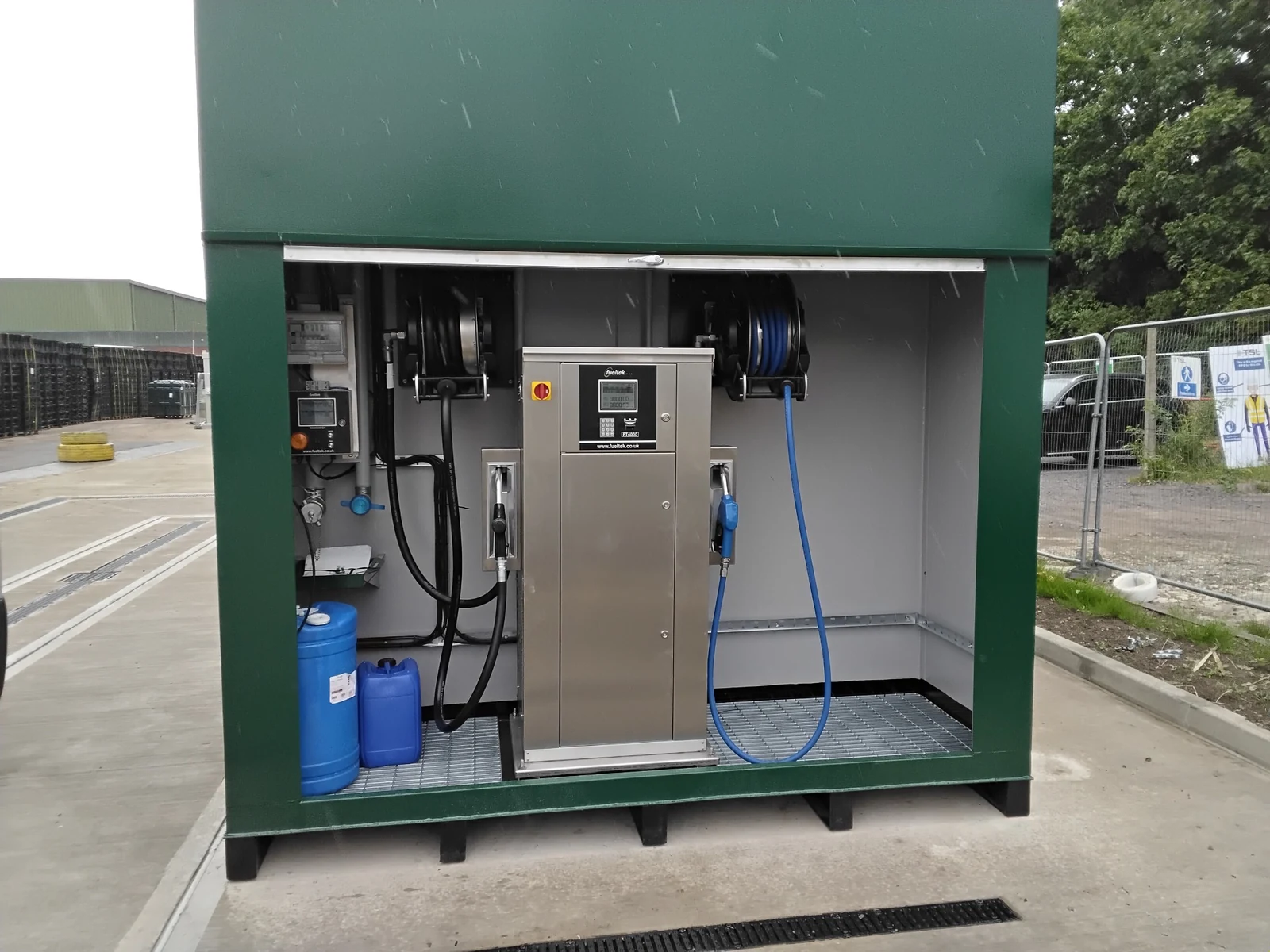
Standard or full-end equipment cabinets and roller-shutter arrangements can be specified. Agree lockable access, who needs entry and the space required to open and service the equipment.
Specify contents gauging, overfill warning and bund-leak monitoring separately. A configured TankWatch arrangement can connect stock information and selected alarms with the wider fuel management system.
Pumps, dispensers, identification and management equipment can be configured around your products, outlets and vehicle layout. Tank-only supply can connect to suitable existing equipment.
Agree connection type, fill-point identification, tanker approach and the delivery-driver interface. Include maintenance clearances and isolation arrangements in the site design.